Tuesday, July 31, 2012

Garden Cremation Pedestals


Since ancient Roman times, cemeteries have been known as gardens, peaceful places of worship. These ancient memory gardens were often meticulously landscaped and adorned with sculptures and monuments. Apart from sanitary and other practical considerations, burial sites were often determined by religious and other social considerations. Religious rules may prescribe a specific zone, for example, some Christian traditions hold that Christians must be buried in "consecrated ground", usually a cemetery or burial in or very near the church. 
 
In North America, private family cemeteries were common among wealthy landowners during the 18th and 19th centuries. Many prominent people were even buried in private cemeteries -made to look like spectacular gardens - on their respective properties.


There are several common alternatives to whole-body burial. In cremation the body of the deceased is burned in a special cremation process. The fragments are then processed into a fine powder, which has led to the cremated remains being referred to as ashes. Cremation has become a very popular option in today's tough economic times.

There is far greater flexibility in dealing with the remains in cremation as opposed to the traditional burial. Some of the options include scattering the ashes at a place close to the heart of the deceased or keeping the ashes at home or in the cremation garden of a cemetery. One of the most unique "garden-like" ways to house ashes is in a Cremation Pedestal.


Various conditions in the late 18th century and throughout the 19th century led to the burial of the dead in graveyards being discontinued. Completely new garden-like places of burial were established away from heavily populated areas and outside of old towns and city centers. Thus, cemeteries - in landscaped or garden form - became the principal place of burial.


More recent is the practice of families with large estates choosing to create private cemeteries in the form of burial sites. Burial of a body at a site may protect the location from redevelopment, with such estates often being placed in the care of a trust or foundation. Presently, state regulations have made it increasingly difficult, if not impossible, to start private cemeteries; many require a plan to care for the site in perpetuity. Be sure to check with local ordinances if you plan to house cremated ashes in your pedestal at home.


There are so many different options for choosing a Cremation Pedestal. With so many subjects to choose from, sometimes it's hard to decide. One of the initial decisions you'll need to make is what type of pedestal you'll want. These range from simple cremation pedestals, cremation pedestals with vases, cremation birdbaths and cremation sundials.


Next, it's up to you to customize your cremation pedestal in the same way you would if it were a granite monument or headstone. You can personalize your granite cremation memorial with just about any subject matter too. Such as the cowboy boots and hat monument below.


Contact your granite monument builder for more information on choosing a granite cremation monument. The vast options that are available for today's cremation garden pedestals may just surprise you!

Tuesday, July 24, 2012

Adding a Portrait to Your Monument


Porcelain portraits are a wonderful way to add your loved one's picture to their monument. They are beautiful, durable, weather resistant, and will not fade. They are available in color, black and white or sepia tone, depending upon your preference. Almost any photo can be used, and in most cases, the background can be altered, or even substituted, to create a truly unique memorial portrait.


If you want to display the photo of a loved one on a headstone
a porcelain portrait plaque may be a very economical choice. Porcelain portraits are available in many shapes and sizes. They can either be recessed into the granite or can be easily placed on the granite surface with a special adhesive tape. Porcelain photographs are created by pouring porcelain over a stainless steel base, firing in a kiln until hard, and transferring the portrait onto the porcelain base. They are then kiln fired again, at a high temperature, which permanently fuses them all together.


Another option for adding a portrait to your monument is laser etching directly into the granite. The digital imaging process for laser etching offers many options, including background removal, digital touch-up, text addition, and other digital modifications. Group photos can be converted to single or couple portraits, and vise-verse. Not only photographs, but drawings, emblems, and entire poems can be added to the portrait.


Raster, bitmap or digital images are then directly etched into the surface with a laser. The granite headstone is placed directly on the laser's table and the prepared file is transferred to the stone. This creates a beautiful portrait that will endure as long as the granite monument itself. Of course, the choice depends upon the granite color as well as the monument design. Check with your monument manufacturer to see what options might be right for you.

Tuesday, July 17, 2012

Where Does Your Granite Come From?


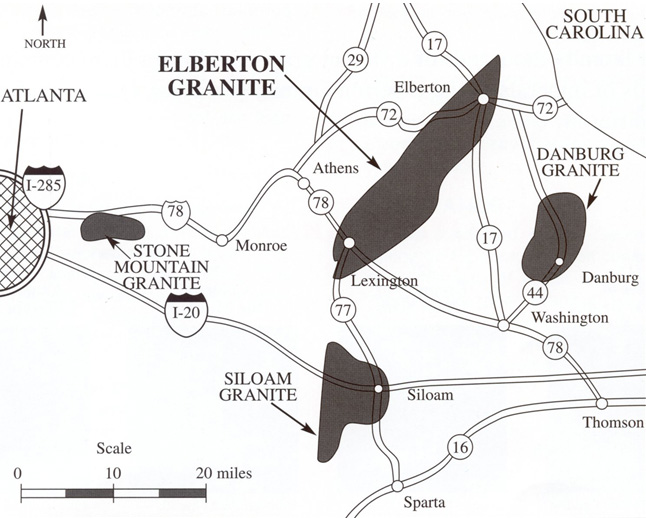
The Elberton Granite deposit is a huge mass roughly 35 miles long, six miles wide, and probably 2-3 miles deep. The total amount of granite in the Elberton area is about 6 million tons. That’s enough granite to fill the Rose Bowl almost two million times!


The Elberton Granite began 325 million years ago as a large, hot (1300-1400 degrees) mass of magma–molten rock. This magma originated when some of the earth’s crust melted–probably at a depth of about 11-12 miles. The magma rose upward and came to rest about nine miles beneath Elberton. There it cooled very slowly–taking over a million years–and solidified into granite.


That was over 300 million years ago. Since then, the granite has been pushed upward, and the land above it has been removed by erosion. The result: Now the granite lies right at the surface where it can be easily, safely, and economically quarried.


The hardest mineral on earth, diamond, has a hardness of 10. It cannot be scratched except by other diamonds. The softest materials have a hardness of 1 and are easily scratched. Few materials except precious stones are harder than 7. Elberton Granite is very hard, 6-7, and very tough to break because its tightly-bonded Quartz and Feldspar grains are made of tightly-bonded atoms. No other natural stone used for commercial purposes is any harder or more difficult to break than granite.


Granites weigh 160–220 pounds per cubic foot. That’s about the same weight as marble and only one-third as heavy as steel, but 2-3 times as heavy as concrete. Granite is heavy for much the same reasons it is so hard–the minerals within it contain tightly-packed atoms. In addition, the mineral grains themselves are also tightly packed.


Photograph taken by Mark A. Wilson (Department of Geology, The College of Wooster)

Granite has been used for gravestones and memorials for centuries. Until the early 18th century granite could only be carved by hand tools. There are a few manufacturers throughout the US who still employ highly-skilled craftsmen that create one-of-a-kind monuments by hand.

 
A key breakthrough was the invention of steam-powered cutting tools which were inspired by ancient Egyptian granite carvings. In 1832 the first polished granite tombstone was erected in an English cemetery. It caused a sensation in the London monumental trade and for some years all polished granite ordered came from one manufacturer. Granite memorials became a major status symbol in Victorian Britain.

Today, modern methods of carving include using computer-controlled rotary bits and sandblasting over a rubber stencil. Leaving the letters, numbers and emblems exposed on the stone, the blaster can create virtually any kind of artwork or epitaph on the granite headstone or granite base.


Thursday, July 12, 2012

Pet Memorials and Pet Loss


The death of a pet can be an intense loss, comparable with the death of a human loved one, or even greater depending on the situation and the individual pet owner. The loss can be even more intense when the owner has made the difficult decision to end the pet’s life through euthanasia. There are other types of loss that can also cause grieving like a missing pet, loss through personal separation/relocation and accidentally injured or killed.


There is no set amount of time for the grieving process. Some pet owners may even be unable to express their grief socially when it results in the loss of a pet. It somehow seems socially acceptable to grieve for the loss of a loved one, but not as much for the loss of a pet. To make things more difficult, men often internalize their feelings, and may feel it necessary to suppress grief altogether.


After the loss of an animal or pet, there are further ways of coping with grief:
  • Change your environment and try putting away pet-related items
  • Adjust your daily routine to avoid pet-related situations
  • Release emotions through writing or other activities
  • Memorialize your pet


Resources for pet loss change regularly, but include: hotlines - some veterinary schools around the US have pet loss support hotlines; online forums - use the search term "pet loss" to locate online forums for grieving pet owners; books - on "pet loss" are available through online and local booksellers.


Pet death is gradually becoming recognized as similar to other forms of death within the family. Some companies may even provide paid leave for such emotional times. Animal chaplains are also becoming popular to help in dealing with the loss of a pet. There are beautiful pet cemeteries throughout the US and a few are now allowing your pet to be buried with you in your plot. Most have great websites explaining what they can and cannot allow at this time, but all are worth exploring. If you prefer to memorialize your pet at home, consider a small marker or monument that can be easily placed without assistance. If you are memorializing a larger animal, such as an equine, a larger monument could be setup while the equipment is there to bury your equine partner. 

Another popular option is cremation, with your pets ashes being kept in an urn. (We'll have that information for you in a later post.)

Monday, July 9, 2012

Symbolism and Memorial Messages


No matter your religious preference, personalizing your monument can be an arduous process in a time of grief. With thousands of designs and religious components available, the design process can sometimes take weeks or months to complete.

Your monument counselor should be able to provide you with the necessary information to get you started. Researching the meaning of certain symbols on your own can also help save time during the memorialization process.

One of the first things you'll need to decide is whether you want a classic granite monument (with sandlblasting/hand carving) or a modern black etched granite monument. This will determine your artwork choices, as certain designs can be different for each type of monument and/or type of granite used.


According to the interpretation of the First Amendment of the U.S. Constitution, it is illegal to display a religious symbol, such as a Christian cross, on public land, as it demonstrates preference to a specific religion and thus violates the separation of church and state. Therefore, you'll need to be aware of your memorial placement if not located within a private cemetery. You should have no trouble adding religious components or scenes to your cemetery headstone. Your counselor can work with you to ensure your monument is appropriate in theme, design, type and size for your cemetery's specifications.


In addition to religious themes, many families choose to add flowers to symbolize how a life was lived or to honor their loved one in passing. For example, very popular monument flowers are red poppies, which have been associated with war since the Napoleonic Wars. The damage done to the landscape during battle often increased the lime content in the soil, leaving the poppy as one of the only plants able to grow. Families often utilize the poppy in headstone designs for family members that have served in the military.


Description=commemorative poppies laid at the Tomb of the Unknown Soldier 
Source=self-made |Date=November 11, 2007 |Location=Ottawa, Ontario Canada 
Author=Benoit Aubry |Permission= Creative Commons 3.1

Other common flowers and their significances are:

Morning Glory: symbolizes the Resurrection, morning, 
youth and the bonds of love. 

Daisy: Innocence of the Holy Child, Jesus the infant, youth, 
the Sun of the Righteousness, and also symbolizes innocence.

Pine and Pine Cones: symbolize fertility, regeneration, and healing.

Lily of the Valley: stands for purity, humility, 
the Virgin Mary and brides.

Tree of Life: Eternal Life.

Cultured and Wild Roses: symbolize love.

Pansy: Remembrance, humility and The Holy Trinity.

Poppy: Peace, rest, sleep, eternal sleep, consolation


By combining religious components, symbolic flowers and, as seen in the monument above, photo etched family portraits, allows for a truly unique and personal family memorial.


Tuesday, June 26, 2012

Angel Monuments Throughout History


Early Christian art featured winged creatures associating the spreading of wings  with a life "beyond what we know and see" on earth. Mankind has since associated these angels with the travel of life into heaven. Guardian angels were thought to protect and guide a particular person through life and/or death. Guardian angel tales can be traced throughout history, and in both Eastern and Western civilizations, it was believed that guardian angels served to protect whichever person they were assigned to.


Guardian angels attending to each and every person has been documented for centuries and can even be seen in both the Old and New Testaments; "how great the dignity of the soul, since each one has from his birth an angel commissioned to guard it". People believed that guardian angels stayed with you from birth, so with the untimely death of a child, the guardian angel for children morphed into a winged-child likeness. The winged-child became popular in both early English and American Colonial cemeteries and became know as a cherub. These representations have became heartfelt additions to children's markers in cemeteries throughout the years.


Many people believed by the 12th century that every soul was assigned a guardian angel the moment it was put into a body. Clement of Alexandria writes in the Eclogae Propheticae: "Scripture says that little children who are exposed are entrusted to a guardian angel, who brings them up and makes them grow; and they shall be, he says, like the faithful here who are a hundred years old."  The existence of angels has been debated throughout the centuries. The mysterious subject matter has even inspired many sculptors to create master works of art with angelic-type themes, such as Michelangelo's Statue of an Angel in the Basilica of San Domenico, Bologna.

By James Steakley (Own work) [CC-BY-SA-3.0 
(www.creativecommons.org/licenses/by-sa/3.0) or GFDL 
(www.gnu.org/copyleft/fdl.html)], via Wikimedia Commons

   
Today, angels bring us comfort, with thoughts of them holding our loved ones and keeping them safe from harm. Adding an angel to your monument can be a very personal and comforting way to memorialize your loved one. There are pre-manufactured angel monuments, ready to personalize, as well as many stock molded angel statues. In-stock statuary usually requires less wait time to install within the cemetery. If you're willing to take some time and work with a sculptor, custom statuary can also be a consideration to create something truly unique. www.centuryharmony.com

Tuesday, June 19, 2012

After Cremation Options


A body that is cremated must be placed in a container prior to cremation. This can be as simple as a cardboard box or a wooden casket especially built for cremation. A second option is a cardboard box that fits inside a wooden shell, which is designed to look like a traditional casket. After the funeral service, the cardboard box is removed from the casket shell prior to cremation. 

After cremation, the cremated remains are returned in a rectangular plastic container, cardboard box, velvet sack or in an urn, if the family has already purchased one. Cremated remains can be kept in an urn (like the granite urn below) which is then usually housed in a cemetery's columbarium, buried in the ground with a grave marker or headstone, interred within a cremation bench (as shown above) or scattered in accordance with the deceased's wishes.


Cremated remains may be scattered in national parks in the U.S. with a special permit or scattered on private property (with the owner's permission). The final disposition depends on the personal wishes of the deceased, as well as their cultural and religious beliefs. Some religions will even allow the cremated remains to be kept at home. Some religions require the burial or entombment of cremated remains.


A peaceful setting, whether in a cemetery, in a private park, or at your own home can be an enjoyable place for a cremation bench, like the one above. Simple and elegant, utilizing only artwork and a family name, you'll be reminded of those you held so dear. Whether choosing entombment in a cemetery, scattering all of the remains, or keeping them at home in a cremation bench, the decision may just require some more time and further thought to weigh out all of your options.

Tuesday, June 12, 2012

A Family Plot in the Cemetery


In addition to funeral services, cemetery property is another consideration when you’re making final arrangements. It's important to tour the cemetery so you can select the type and location of cemetery property that is right for you and your family. Regardless of whether your choice is burial or cremation, permanent memorials can create a lasting heritage for your family.


Most people are familiar with the concept of burial but may not be aware of the variety of options that are often available. Private Family Estates (also called Family Plots) are small areas within the cemetery that allow for burial of several members of the same family. They are generally separated by gates, shrubbery, or other dividers, like the granite coping shown above.


Memorial benches are benches that either simply memorialize a loved one scattered or buried in a cremation garden, or actually contain the remains within the bench itself. Many families choose to add a bench to their family plot to create a garden like place where family members can find peace and reflect upon their loved ones.

  
A permanent family plot can also give loved ones a physical place for visitation. The ceremony accompanying the placement of an urn in a cremation niche or a cremation garden in a cemetery provides family and friends with closure after the loss of a loved one. And having a place to come back to can sometimes help keep memories close for those who are still here.


Some cemeteries allow upright headstones, called monuments, to be used with ground burials. Headstones that are flat against the ground are called flat markers or grass markers. It is not unusual to combine the two when creating the perfect family estate. In some cemeteries, or sections of cemeteries, only flat markers are used to preserve the natural appearance of the landscape and help reduce grounds maintenance and lessen the risk of damage to the granite from mowers and lawn equipment.


Many people overlook the importance of cemetery property for those who choose cremation, but permanent placement of the ashes (cremains) is an important part of memorialization too. Having a private place to honor family members that have been cremated is just as important as for those who choose burial. The fact remains that you are still creating a special place for family members now and into the future.


As future generations may not feel a connection with the deceased, a permanent family plot can provide a wonderful spot to visit when researching their own family history. Granite mausoleums, like the ones shown in the family estate above, can be considered a blank canvas for personalizing your memorial with names and dates, religious and personal components, versus, and laser etched photos of family or special pets. Make a family plot the place to honor your family's lifestyle and beliefs.


Tuesday, June 5, 2012

Adding Cemetery Vases to Monuments


There are a few things to consider when deciding to purchase granite or marble cemetery vases. Consider how often you expect to visit the memorial. If your family is going to the cemetery frequently, it would be practical to add vases for your flowers. If your family visits the cemetery occasionally, it may not be a necessary expense. Also, you should consider the type of cemetery in which you have your plot. Some cemeteries remove flowers within a few days or a week of placement. Be sure to check with your cemetery for specific regulations concerning flowers and placement of other memorial items.


When adding a vase, the size of the granite base must be longer than normal size - to accommodate the placement of the vase. Likewise, if two vases are ordered, the base must be long enough to allow clearance on each side of the monument. The size of the vase(s) should be consistent with the size of the monument. Therefore, the larger the monument, the larger the vase(s) that can be added.


Bronze and other metal vases are specially manufactured for flat granite marker bases. They can be removed from the granite base, turned upside down, and sunk below the granite, to form a flush surface with the ground. This allows the cemetery to maintain the grounds without damaging the vases.


The design, look and feel of your monument will determine the size, shape and color of your vases. This is another opportunity to personalize your memorial. Many manufacturers can etch, sandblast or carve designs directly onto your granite or marble vases. Additionally, be sure to protect your investment with a vase liner. This allows water to be removed from the vase - to keep the granite from freezing and cracking in more extreme winter climates. 

Whether you choose a more cylindrical turned granite or marble vase, a more bold square granite vase, or a bronze or metal vase for your flush granite marker, consult with a memorial counselor to see all of the options that are available to you.